
Past Campaigns
WATCH has helped thousands of local residents take action on issues that are important to the health of their community and the City overall. These stories are an important part of Waltham’s history, as well as WATCH’s.
Whelan Apartments Tenants’ Association
Tenants at this state-owned senior public housing development wanted to form an association that would have legal recognition by the Waltham Housing Authority in order to ensure that they could get attention and action around the conditions of their housing. Tenants gained information about the regulations that govern public housing tenants’ associations, talked to their neighbors about the benefits of forming such a group, nominated budding leaders to stand for office in a new association, and in late March 2011, they held elections. Now the Whelan Apartments Tenants’ Association is officially formed! The Housing Authority is obligated to communicate with the tenants about problems that arise and the tenants have an organized way to ensure that their concerns about their homes are heard.
This campaign falls under the priority WATCH members identified last year to build better working relationships between tenants and landlords. That priority was part of a housing plan WATCH members created after establishing the Community Housing Principles to guide our work in this area.
.
No on Question 2
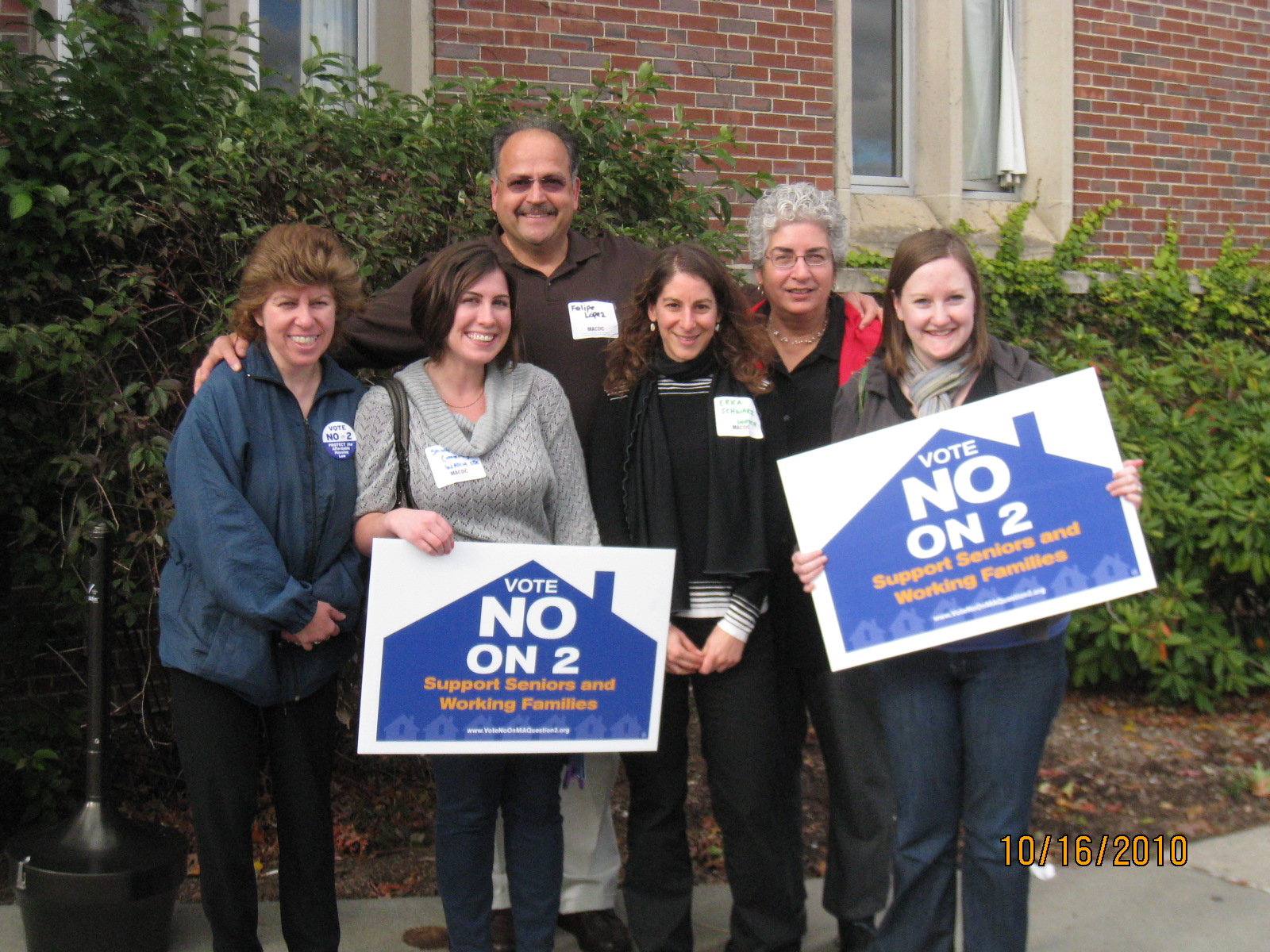
On Election Day in November, 2010, voters were asked if they wanted to eliminate the state’s primary affordable housing law – also called chapter 40B. This law supported the creation of most of the affordable housing that exists outside of Greater Boston. It is key in helping nonprofit developers save time and money as they move housing deals forward, especially in the suburbs, but throughout the state. It helps ensure that working people who do not earn huge salaries have options on where to live. It creates housing for low- and moderate-income families who otherwise woudl be priced out of their community. WATCH helped to save the law from elimination – over the previous five months we had organized volunteers to make thousands of phone calls to talk to voters about the importance of the law for Waltham and the entire state. 58% of the state voted No on Number 2, and Waltham voted just below the state average with 55% voting No in order to support affordable housing. This is impressive as many thought Waltham may have seen a Yes vote majority. Dick Scobie, past WATCH board president and current dedicated volunteer, spent hours on the phone with Waltham voters. Of this experience Dick says, “The most satisfying part, for me, was having conversations with people who were genuinely confused by the question, helping them to get a better understanding of the law and the reasons it was important to keep it on the books.” On Election Day WATCH members came together to stand outside in the cold, holding signs to show their support for the affordable housing law. Doreen Frigo, longtime WATCH member, felt that “holding a sign for a voting issue was a key in receiving support.” WATCH members’ efforts played a key role in Waltham’s part to protect this important law.
TORCH: Tenants Organized to Reform Community Housing
Growing Waltham’s Roots
In 2005 WATCH and the Waltham Land Trust formed a committee to educate the public about the Community Preservation Act and advocate for its passage. The CPA is a state policy that allows cities and town to collect a small surcharge on property tax, to be matched by state funds. The total pot, around $3 million a year for Waltham, can only be spent on affordable housing, open space and historic preservation projects, as determined by a locally appointed committee. WATCH, the Waltham Land Trust and other allies put on public education events, sponsored mailings and made phone calls to voters to talk with them about the benefits of the CPA. The initiative passed by 9 votes, resulting in a recount. The victory still held after the recount, ensuring millions of dollars for important community projects in Waltham. Waltham’s Community Preservation Committee began voting on proposals and disbursing funds in 2006, resulting in vital community projects that might not have happened if not for the CPA. These projects include:
- Preserving at least part of the former Fernald State School land for community use
- Renovating Waltham’s public housing
- Conserving open space on the north side of the City
- As of early 2010, the CPC has recommended that the Council approve WATCH’s request for funds to help purchase the land for our Jackson Street project. After the Law Department reviews the request, we hope the City Council will give their final approval.
Gardencrest Tenants Association: Campaign for a Fair Solution
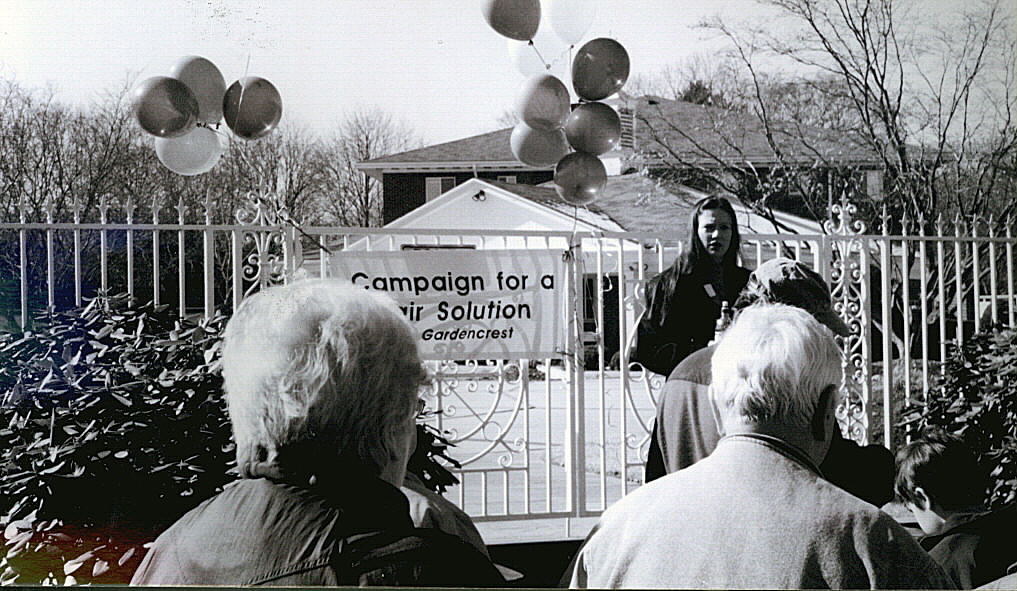
In 2001, as the housing market was turning red hot, Sarah Robbins, now a WATCH board member, walked into the WATCH office to ask for help. Gardencrest Apartments, where she lived, had been put up for sale. The property had been home to 696 of Waltham’s working families for more than 50 years (the vast majority of tenants were elderly or low-income or both), and Sarah was concerned for herself and for her neighbors.
WATCH made a strong offer to buy the complex for $70 million. Instead, in early July, 2002, it sold for $85 million to Home Properties, a Rochester, NY-based company. Immediately after the sale was complete, Home Properties notified tenants whose leases would be up in September that their rents would increase by $80. These notices were just the first step in Home Properties’ plan to increase rents by 40 – 45% over 4 years.
WATCH helped the tenants organize when Sarah came to WATCH with the first rumors of a sale. By the time Home Properties had acquired the property, the tenants were ready. Over 250 tenants participated in meetings, letter writing campaigns and petitions. The effort was covered in the Daily News Tribune, Boston Globe, Banker and Tradesman and Dollars & Sense Magazine.
The tenants’ public awareness work led Ward 6 Councillor Ken Doucette and At-Large Councillor David Marcou to create a rent subsidy program, using funds previously collected under inclusionary zoning. Low-income tenants could receive a monthly rental subsidy 2 years. The tenants wanted to reduce the rent increases, not to subsidize their landlord with local resources, but in the absence of an agreement with the landlord, they were grateful for the subsidy.
In early 2003 the Gardencrest Tenants Association’s campaign paid off. After collecting over 120 signatures on a petition noting that tenants would withhold rent increases if Home Properties did not negotiate in good faith, Home Properties’ CEO Nelson Leenhouts finally engaged in negotiations about rent increases. This first productive meeting was followed by negotiations via fax and phone with the Tenants association using advice from WATCH staff as well as from local attorney Gene Burkhart.
By the time summer rolled around, the tenants and Home Properties CEO Nelson Leenhouts had a signed agreement that capped the rents of all low-income tenants to no more than 5% for 4 years. This agreement affected more tenants than any other private agreement to date in Massachusetts regarding rent levels. The final paperwork was signed at an outdoor party on the Gardencrest property in July 2003.
Charles/Felton Neighborhood Association
Between 2000 and 2004 residents of the Charles & Felton Streets Neighborhood organized to address traffic and street safety concerns. They hosted several community events including a cleanup of the neighborhood park. The group also submitted a request to the City for Community Development Block Grant funds to upgrade Thompson Park, one of the most used parks, yet with some of the oldest equipment. The City approved the request. Neighborhood leaders met with City officials regarding resident’s desires for the park’s design and and the City created a beautiful, new park complete with a water feature for kids to in on hot summer days. Neighbors, WATCH staff, Mayor Jeannette McCarthy and Ward Councillor Gary Marchese attended a ceremony of the opening of the new park in Spring 2005.
Northgate Heights
In 1998, the real estate market was just starting to tighten up. Northgate Heights became Waltham’s first major and very public fight between a new landlord and tenants. A subsidiary of MetLife bought the property and immediate increased rents by $350 per month. The tenants couldn’t handle such dramatic increases.
After many meetings, rallies, editorials and petitions, the City Council voted to boycott MetLife Insurance because of their mistreatment of the Northgate Heights Tenants.
Ultimately, MetLife did agree to reduce rent increases for low-income families and provided a modest moving allowance for families forced out. The campaign clearly put the plight of tenants at the forefront of people’s minds. Tenant Association leader David Feld wrote up the following lessons he learned after from the campaign:
1) Federal and state laws, and local housing ordinances are not strong enough to protect renters and communities from irresponsibly run corporations.
2) Corporate officers tell city officials and renters just how much they love the community while they are dismantling it.
3) People are extremely afraid of corporations by their threats of eviction, and slander, and they are afraid that a corporation will damage their credit rating. This is especially true but not limited to the elderly. Hence, people are afraid to use their constitutional right of free speech and they are afraid to exercise their legal rights!
4) Huge and sudden rental increases do not optimize the net good of society! Forcing a working person or a retiree to leave their community of many years on short notice is not offset by a slightly larger bonus for a corporate officer or a slight increase to an investor’s piggy bank.
5) Strong community organizations are required to offset the wrongs of 1-4 above! That’s why we need to support organizations like WATCH to inform people of their legal rights and to help people to organize and to educate people early on in a crisis before it’s too late. It’s equally important for community organizations to educate corporations that a little bit of corporate good will can benefit a corporation much more than the damage of being embarrassed and “outed” as a bad corporate citizen in the press and in the community.